

HELOC vs Home Equity Loan: Which Is Better for Homeowners?

If you own a home, you may be sitting on one of the most powerful financial tools available: your home equity.
Many homeowners today have hundreds of thousands of dollars in equity but aren’t sure how to access it wisely.
Two of the most common ways to unlock that equity are:
HELOC (Home Equity Line of Credit)
Home Equity Loan
Both allow you to borrow against the value of your home, but they work very differently. Understanding the difference can help you choose the right strategy for renovations, investments, or financial flexibility.
What Is Home Equity?
Home equity is simply the difference between your home's value and what you owe on your mortgage.
Example:
Home value: $1,000,000
Mortgage balance: $600,000
Your equity = $400,000
Most lenders will allow homeowners to borrow up to 80–85% of their home's value, depending on qualifications.
That means in this example you could potentially access $200,000–$250,000 of liquidity.
What Is a HELOC?
A HELOC (Home Equity Line of Credit) works like a credit card secured by your home.
Instead of receiving a lump sum, the lender approves you for a credit line that you can borrow from whenever you need it.
For example:
If you are approved for a $250,000 HELOC, you might:
Borrow $20,000 for a renovation
Borrow another $30,000 later
Pay some of it back
Borrow again if needed
You only pay interest on the amount you actually use.
Most HELOCs have two phases:
Draw Period (typically 10 years)
You can borrow as needed and often make interest-only payments.Repayment Period (10–20 years)
Borrowing stops and you begin paying principal and interest.
Advantages of a HELOC
Flexible access to funds
Interest charged only on the amount used
Useful for renovations or projects with uncertain costs
Can serve as a financial safety net or liquidity line
Potential Downsides of a HELOC
Most HELOC rates are variable
Payments can increase if interest rates rise
Requires discipline to avoid overspending
What Is a Home Equity Loan?
A Home Equity Loan is sometimes called a second mortgage.
Instead of a credit line, the lender provides one lump sum upfront, and you repay it with fixed monthly payments over time.
Example:
Loan amount: $100,000
Interest rate: 7% fixed
Term: 20 years
Your payment remains predictable and fixed for the life of the loan.
Advantages of a Home Equity Loan
Fixed interest rate
Stable monthly payment
Ideal for large known expenses
Examples include:
Major home renovations
Debt consolidation
Large one-time purchases
Downsides of a Home Equity Loan
Less flexible than a HELOC
Interest begins on the entire loan immediately
Funds cannot be re-borrowed once paid down
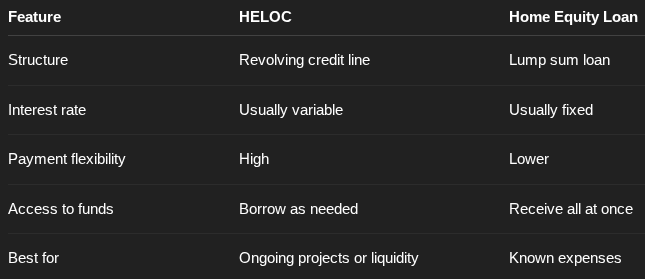
HELOC vs Home Equity Loan (Quick Comparison)
Which Option Is Right for You?
A HELOC may be best if you:
Plan to renovate over time
Want a liquidity safety net
Prefer borrowing only what you need
Value flexibility
A Home Equity Loan may be better if you:
Need a specific amount of money upfront
Want predictable fixed payments
Prefer protection from rising interest rates
A Strategy Many Homeowners Use
Even homeowners who don’t currently need funds sometimes open a HELOC as a financial backup plan.
Why?
Because once approved, it gives them access to liquidity when opportunities or emergencies arise.
Think of it as a financial safety net attached to your home equity.
Curious How Much Equity You Could Access?
Every homeowner’s situation is different. Loan limits depend on:
Home value
Current mortgage balance
Credit profile
Income and debt levels
If you’d like to explore your options, I’m happy to help.
As a mortgage advisor, I work with multiple wholesale lenders to help homeowners find the most competitive equity financing solutions available.
Request a Free Home Equity Consultation
If you're considering tapping into your home equity, I can help you:
Estimate how much equity you can access
Compare HELOC vs home equity loan options
Evaluate rates and lender programs
Structure the best solution for your goals
Schedule a consultation or feel free to reach out directly.
The right equity strategy can turn your home into a powerful financial tool.