How Homeowners 65+ Can Help Their Kids Financially: Mortgage & Reverse Mortgage Options Explained

If you're 65 or older and your home is paid off (or close to it), you're likely sitting on your largest financial asset. At the same time, you may be watching your adult children struggle with something you never had to think much about at their age: getting into a home of their own.
You want to help. The question is how—without jeopardizing your own retirement, your income, or your peace of mind.
The truth is, there's no single "best" way to do this. The right answer depends on your age, how much equity you've built, whether you still carry a mortgage, and how much monthly payment (if any) you're willing to take on. Below is a breakdown of the main options homeowners 65 and older typically consider, and how to think about which one fits your situation.
First, Get Clear on Your Equity
Before anything else, it helps to know two numbers: what your home is worth today, and what (if anything) you still owe on it. The gap between those two is your equity, and it's the foundation for every option below. A home equity review can give you both numbers along with realistic borrowing ranges, so you're working from facts rather than guesses.
Option 1: Fixed Second Mortgage (Home Equity Loan)
A fixed second mortgage lets you borrow a lump sum against your equity, on a separate loan behind your existing mortgage, with a fixed rate and fixed monthly payment.
Best for: A specific, one-time amount—like a down payment gift—when you're comfortable taking on a new monthly payment and want the predictability of a fixed rate.
Keep in mind: This adds a real monthly obligation. If you're on a fixed retirement income, it's worth stress-testing the payment against your budget before committing.
Option 2: HELOC (Home Equity Line of Credit)
A HELOC works more like a credit card secured by your home. You're approved for a credit limit and draw only what you need, when you need it, with a variable interest rate.
Best for: Homeowners who aren't sure of the exact amount they want to give, or who want flexibility to help with a down payment now and other expenses (tuition, a wedding, an emergency) later.
Keep in mind: Because the rate is variable, your payment can change over time. It also requires the discipline to manage a revolving line rather than a fixed schedule.
Option 3: Cash-Out Refinance
This replaces your current mortgage with a new, larger one, and you take the difference in cash.
Best for: Homeowners who don't yet have a mortgage rate worth protecting, or whose current rate is higher than today's rates.
Keep in mind: If you already have a low rate from a few years ago, refinancing usually means trading it in for a higher one on your entire loan balance—not just the amount you're pulling out. For most homeowners with an older, low-rate mortgage, a second mortgage or HELOC preserves that rate more effectively.
Option 4: Reverse Mortgage (HECM)
This is where things look different for the 65+ homeowner, because you gain access to a product younger buyers can't use: the Home Equity Conversion Mortgage (HECM), the FHA-insured reverse mortgage available starting at age 62.
With a reverse mortgage, you access your equity—as a lump sum, a line of credit, monthly payments, or a combination—without a required monthly mortgage payment. The loan is repaid when you sell the home, move out permanently, or pass away, typically from the home's sale proceeds. You remain the owner of your home and are still responsible for property taxes, insurance, and upkeep.
Best for: Homeowners who want to access equity without adding a new monthly payment to their budget—which can make it easier to help a child financially without straining monthly cash flow in retirement.
Keep in mind: Reverse mortgages have upfront costs, reduce the equity left in the home over time, and aren't the right fit for everyone. They deserve a careful, honest conversation—not a sales pitch—before moving forward. Because your children may eventually inherit the home, it's often worth including them in that conversation too.
Option 5: Reverse Mortgage for Purchase (H4P)
Less well known, but worth mentioning: if you're 62 or older and thinking about downsizing or relocating rather than staying put, a Home Equity Conversion Mortgage for Purchase lets you buy a new home using a reverse mortgage, often with a lower cash outlay than a traditional purchase. Freeing up equity this way can also open the door to helping your kids with the proceeds from your current home sale.
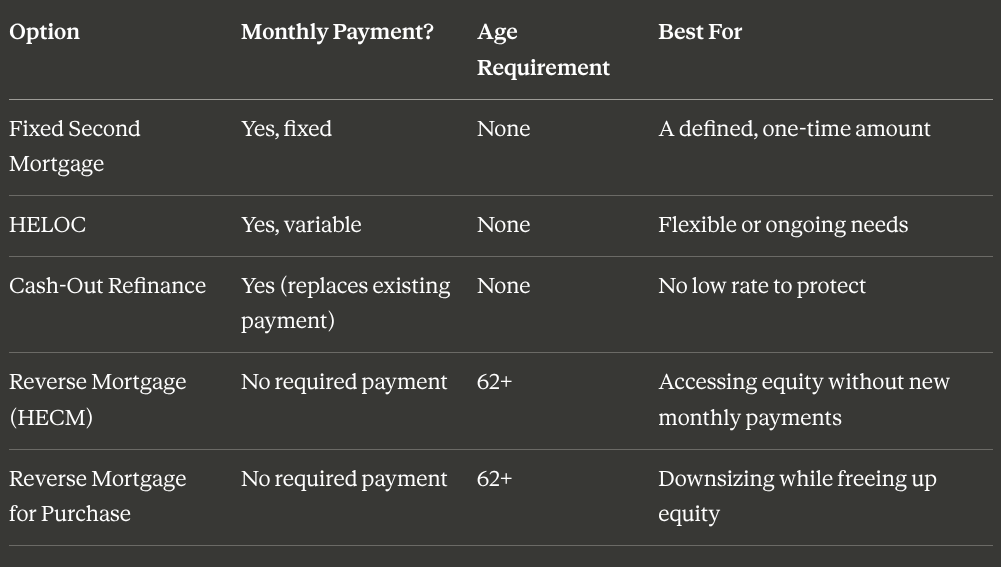
Comparing the Options at a Glance
Beyond Mortgage Products: Other Ways to Help
Not every form of help involves borrowing at all. Some homeowners choose to:
Sell and downsize, using part of the proceeds to help a child while reducing their own housing costs.
Co-sign or co-borrow on their child's mortgage, which can help with qualification but comes with real shared liability.
Set up a family loan with a signed agreement and modest interest rate, which can also carry estate planning benefits.
These aren't mortgage products, but they're worth having on the table alongside the equity-based options above.
Questions Worth Asking Before You Decide
Do I need a lump sum, ongoing flexibility, or no new payment at all?
Do I currently have a mortgage rate worth protecting?
How would each option affect what I can leave to my children later?
Am I comfortable with my children knowing the details, especially if a reverse mortgage is involved?
What does this do to my monthly cash flow in retirement, both now and years from now?
There's rarely a single "right" answer—only the option that fits your equity, your income, and your family's goals.
Let's Look at Your Specific Numbers
Every homeowner's situation is different, and the right option depends on your equity, your existing mortgage (if any), your age, and what you're trying to accomplish for your family. I help California homeowners 65 and older understand exactly what's available to them—clearly, honestly, and without pressure.
Call me directly at (323) 364-7855, or request your Free Home Equity & Options Review to walk through what makes sense for you.
Frequently Asked Questions
What's the difference between a HELOC, a fixed second mortgage, and a reverse mortgage? A HELOC and fixed second mortgage both require monthly payments and are available at any age. A reverse mortgage, available at 62+, lets you access equity without a required monthly payment, with the loan repaid later from the home's value.
Do I have to be 65 to get a reverse mortgage? The minimum age for a HECM reverse mortgage is 62. Being 65 or older doesn't change the requirements, but it does mean you're comfortably past the minimum eligibility age.
Will I still own my home if I get a reverse mortgage? Yes. You remain the owner and are responsible for property taxes, homeowners insurance, and upkeep, just as with any mortgage.
Can I use a reverse mortgage specifically to help my kids with a down payment? Yes, funds from a reverse mortgage can generally be used for any purpose, including gifting toward a down payment, though it's worth discussing the long-term impact on your equity and estate first.
Which option protects my existing low mortgage rate? A HELOC, fixed second mortgage, or reverse mortgage can all be structured to leave your first mortgage untouched. A cash-out refinance replaces it entirely, which usually isn't ideal if your current rate is low.
This article is for general informational purposes and is not a commitment to lend. Reverse mortgage products require HUD counseling and have eligibility requirements and costs. Equal Housing Opportunity | Equal Housing Lender.