Reverse Mortgages Explained: HECM vs. Private (Proprietary) Reverse Mortgages

"Reverse mortgage" gets used as if it's one single product, but it isn't. There are actually two distinct categories, and which one fits you can depend heavily on your home's value, your age, and what you're trying to accomplish.
The first, and by far the most common, is the HECM—a Home Equity Conversion Mortgage, insured by the federal government through the FHA. The second is a private (or proprietary) reverse mortgage, offered directly by individual lenders without government insurance, usually aimed at homeowners with higher-value properties.
This guide walks through how each works, where they differ, and how to think about which one—if either—makes sense for you.
What Is a Reverse Mortgage, in Plain Terms?
A reverse mortgage lets homeowners 62 and older convert part of their home equity into cash—as a lump sum, a line of credit, monthly payments, or some combination—without making required monthly mortgage payments.
You remain the owner of the home. You're still responsible for property taxes, homeowners insurance, and upkeep. The loan balance grows over time as interest accrues, and it's repaid when the home is sold, you move out permanently, or you pass away—typically from the home's sale proceeds. Any remaining equity after the loan is repaid belongs to you or your heirs.
That's the shared foundation. From here, HECMs and private reverse mortgages start to look quite different.
HECM: The Government-Insured Option
The HECM is the original and still the dominant reverse mortgage product, insured by the Federal Housing Administration (FHA) and available through FHA-approved lenders nationwide.
Key features:
Federally insured, which protects you if your loan balance ever exceeds your home's value—you (or your heirs) will never owe more than the home is worth at repayment, regardless of the loan balance.
Lending limits. HECMs are capped at a maximum "claimable" home value set annually by the FHA, which limits how much equity you can access even if your home is worth significantly more.
Mandatory HUD counseling. Before closing a HECM, you're required to complete a session with an independent, HUD-approved counselor, so you fully understand the terms before committing.
Flexible payout options, including a growing line of credit, which some homeowners use strategically as part of a broader retirement income plan.
Mortgage insurance premiums, paid to fund the FHA insurance that protects you.
Best for: Most homeowners considering a reverse mortgage, particularly those whose home value falls within or near the FHA lending limit, and who want the added protection of a federally regulated, insured product.
Private (Proprietary) Reverse Mortgages: The Non-Government Option
Private reverse mortgages, sometimes called proprietary or jumbo reverse mortgages, are created and offered directly by individual lenders. They aren't insured by the FHA and don't follow HECM lending limits.
Key features:
Higher loan limits. This is the main reason they exist—if your home is worth well above the FHA's HECM limit, a private reverse mortgage can allow you to access a larger dollar amount of your equity.
No FHA mortgage insurance premiums, which can lower some of the upfront and ongoing costs compared to a HECM, though terms vary significantly by lender.
No federally mandated counseling requirement, though many reputable lenders still recommend or require independent counseling as a matter of practice.
Lender-specific terms. Because these aren't standardized by a federal program, rates, fees, and payout structures can vary considerably from one lender to the next.
Not federally insured, so it's especially important to understand exactly how the loan is structured and what protections (if any) the lender provides.
Best for: Homeowners with higher-value homes who want to access more equity than a HECM allows, and who are working with a lender they trust to walk them through the specifics clearly.
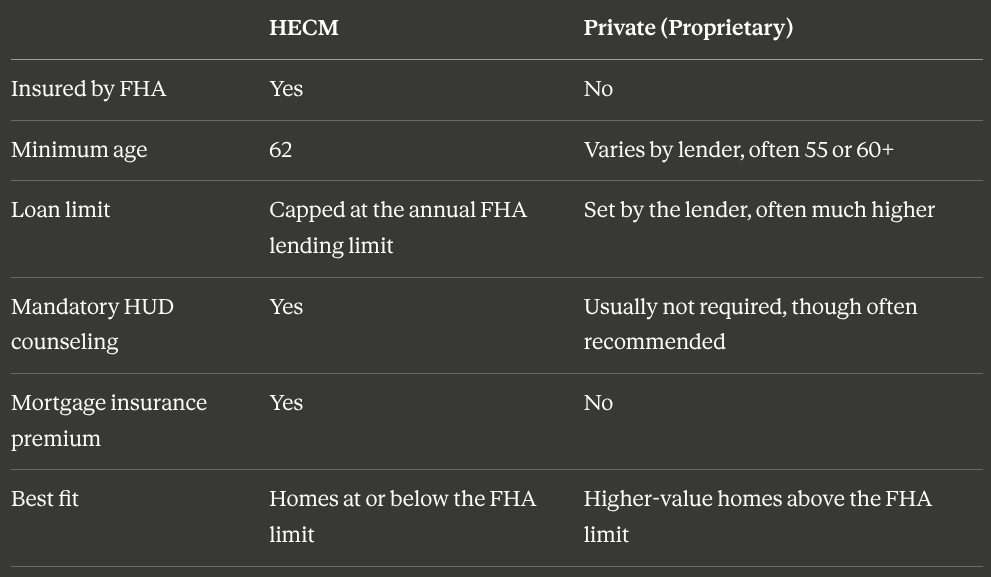
HECM vs. Private Reverse Mortgage: Side-by-Side
How to Think About Which One Fits You
A few questions can help point you in the right direction:
What is your home actually worth? If your home's value is close to or under the current FHA HECM limit, a HECM likely gives you access to most or all of the equity you'd want anyway, along with the added protection of federal insurance.
Is your home worth significantly more than the FHA limit? If so, a HECM would only let you borrow against a portion of your equity, and a private reverse mortgage may allow access to more of it.
How much do you value the federal insurance protection? The FHA's guarantee that you'll never owe more than the home is worth is a meaningful protection. Some private products offer similar non-recourse protection, but it's not guaranteed across the board—this is a question to ask directly of any private lender.
Do you want the built-in structure of HUD counseling? Some homeowners appreciate having an independent third party walk through the terms before committing. If that matters to you, factor it into your comparison even if a private lender doesn't require it.
What Reverse Mortgages Are Often Used For
Regardless of which type you choose, homeowners typically use reverse mortgage proceeds to:
Supplement retirement income
Pay off an existing mortgage and eliminate a monthly payment
Cover healthcare or long-term care costs
Help adult children with a down payment or other financial need
Create a standby line of credit for future flexibility
Things Worth Knowing Before You Move Forward
Costs matter. Both HECM and private reverse mortgages carry upfront costs (origination fees, closing costs, and for HECMs, mortgage insurance premiums). Ask for a clear, itemized breakdown before comparing options.
Your equity will decrease over time as interest accrues on the loan balance, which affects what's left for you or your heirs later.
Heirs should be part of the conversation. Since the loan is typically repaid from the home's sale, it's worth discussing your plans with your children or beneficiaries so there are no surprises.
Not every homeowner should get one. If you're planning to move in the next few years, a reverse mortgage's upfront costs may not make sense for a short holding period.
Get Honest Guidance Before You Decide
Reverse mortgages—HECM or private—are significant financial decisions, and the right fit depends entirely on your home's value, your age, and your goals. I help California homeowners understand exactly what's available, compare their real options side by side, and move forward only if it genuinely makes sense.
Call me directly at (323) 364-7855, or request your Free Home Equity & Options Review to talk through your specific situation.
Frequently Asked Questions
What's the main difference between a HECM and a private reverse mortgage? A HECM is insured by the FHA and capped at an annual federal lending limit, with mandatory HUD counseling. A private reverse mortgage is offered directly by a lender, isn't federally insured, and often allows access to more equity on higher-value homes.
Which one lets me borrow more money? It depends on your home's value. If your home is worth more than the FHA's HECM limit, a private reverse mortgage may allow you to access a larger amount. If your home falls within the limit, a HECM often provides comparable or sufficient access with added federal protections.
Do I have to complete counseling for a private reverse mortgage? Not always—HUD counseling is a federal requirement specifically for HECMs. Many private lenders still recommend or require independent counseling, but it isn't mandated the same way.
Is a private reverse mortgage riskier than a HECM? Not necessarily, but it isn't federally insured, so protections like the guarantee that you'll never owe more than your home's value can vary by lender. It's important to review these terms carefully with any private lender.
Can reverse mortgage funds be used to help my children financially? Yes. Many homeowners use reverse mortgage proceeds for exactly this purpose, whether it's a down payment gift, a family loan, or other financial support, though it's worth weighing the long-term impact on your equity and estate first.
At what age can I get a reverse mortgage? HECMs are available starting at age 62. Some private reverse mortgage products have lower minimum age requirements, often 55 or 60, depending on the lender.
This article is for general informational purposes and is not a commitment to lend. Reverse mortgage products require HUD counseling and have eligibility requirements and costs. Equal Housing Opportunity | Equal Housing Lender.